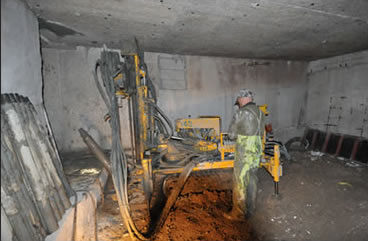
When to use micropiles
Micropiles are suitable for a number of undertakings:
- foundations of buildings or artistic structures
- retaining structures (micro Berlinese walls)
- stabilization of landslides
- installation of protective devices
- underpinning works
The mechanics of micropiles
Micropiles may be exposed to two types of forces :
- compression/traction strains
- shear strains
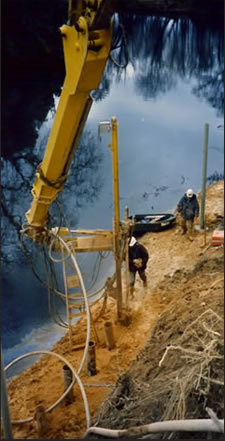
Sheathing
If the environment is not stable, the use of a temporary sheath may be necessary to retrieve the drilling material and to set up the armature. This objective can be attained by implementing ODEX, a technique that makes it possible to use a sheath as work progresses.
Corrosion
The metal armatures in use are susceptible to corrosion. When calculating dimensions it should be taken into account that the outer layer will be subjected to corrosion and will wear off.
Injection
The micropile must be covered in grout to ensure that the armature remains sealed to the ground. This technique protects the armature against corrosion, and makes it possible to transfer the strains to the ground.
Several types of injection are possible:
- GSI (Global Single Injection) from the bottom of the hole
- SRI (Selective Repeated Injection) meaning the grout is injected into drilled holes at a given pressure
Connexions with the structures
Micropiles require a more or less significant absorber base. Installing sills and concrete blocks makes it possible to transfer the strains exercised on the structure to the micropiles.
Armatures
Whereas in some cases the use of full metal bars may be contemplated, it is generally more common to resort to steel tubes or metal profiles (HEA, IPN) which may compensate heavier loads and flexion strains.
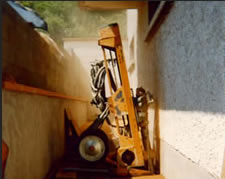
A few figures
- drilling diameters from 100 to 250 mm
- tube diameters 60 to 78 mm
- inclines comprised between 90 y 80
A few maximum vertical-load values for a micropile anchored 2 m deep into a particular terrain :
| Drill diameters | 140 mm | 200 mm |
| When sealed to rock | 9 tons | 13 tons |
| When sealed into the soil | 1.8 tons | 2.6 tons |
Thierry’s advice about micropiles :
« When carrying out underpinning works, it is necessary to refer to an accurate sketch of existing foundations as well as a thorough geotechnical report. It must be kept in mind that the experience of the worker operating the drill is of utmost importance. »