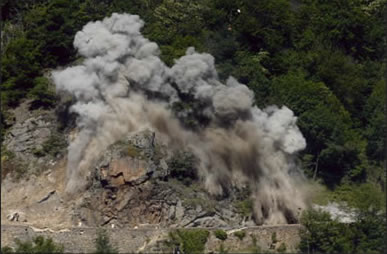
Field of application
Blasting techniques are essentially applied to rocky materials.
Blasting may serve several purposes:
- excavating or leveling out rocky massifs
- stabilizing potentially unstable rocky areas
- excavating or expanding underground works (wells, tunnels…)
Basic Principles
Blasting consists in fragmenting rocks by inserting explosives in a drill hole. Although a single charge may suffice to fragment a simple block, rocky massifs require more or less closely-packed multiple charges.
Two types of energy come into play when using explosives:
– the shock wave;
– gas pressure.
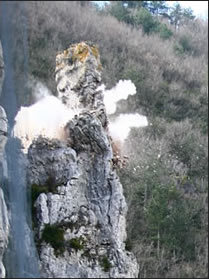
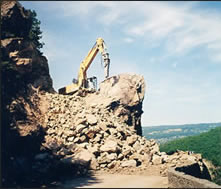
Different types of explosives
There are two main types of explosives:
- deflagrating explosives (black powder)
- detonating explosives (the most common kind)
There are three main groups of explosives:
- dynamite: a nitroglycerine-based product, it is suitable for massive rocks
- ANFO (aluminum nitrate – fuel oil): larger quantities of this explosive are needed as it is less efficient. It should not be used when the rocks present cavities
- emulsion: this explosive may be used in a number of ways and therefore has a relatively wide field of action.
Explosives ill only work when associated with a detonating device and a priming device (pyrotechnic, micro-timed electric, electronic (sequential) or non-electric detonator).
Explosives are classified according to various parameters :
- detonation speed: it is the speed at which the reaction process propagates in the mass of the explosive
- critical diameter: it is the diameter under which the explosive will not detonate
- specific energy, which is the sum of the gas-generated energy and the shockwave-generated energy
- density
- sensitivity to priming
- water resistance
Firing plan
The firing plan is a document that must list certain elements of information elaborated by the engineer:
- firing location
- drilling characteristics (diametre, depth, inclination, number of drilled holes, CUI – single-detonation charge…);
- characteristics of the device including type of explosive, priming, packing…
- priming sequence
Drilling
Drilling operations matter because they will determine the quality of the firing plan.

Philippe’s advice about Blasting :
“Pre-zoning detonations make it possible to individualize the masses to be mined and hence limit the impact of Blasting on the non-excavated areas bordering the zone of activity.”
Caution measures relative to Blasting
Blasting is often a quite impressive technique that may generate a number of risks and nuisances which can be perfectly controlled if the company undertaking the works is competent.
- Provisions can be made for trial detonations in order to validate the CUI (single-detonation charge
- Vibration recordings may be carried out in order not to exceed the noise threshold criteria
- Protections against projections may be installed (geotextiles, wire netting…)